
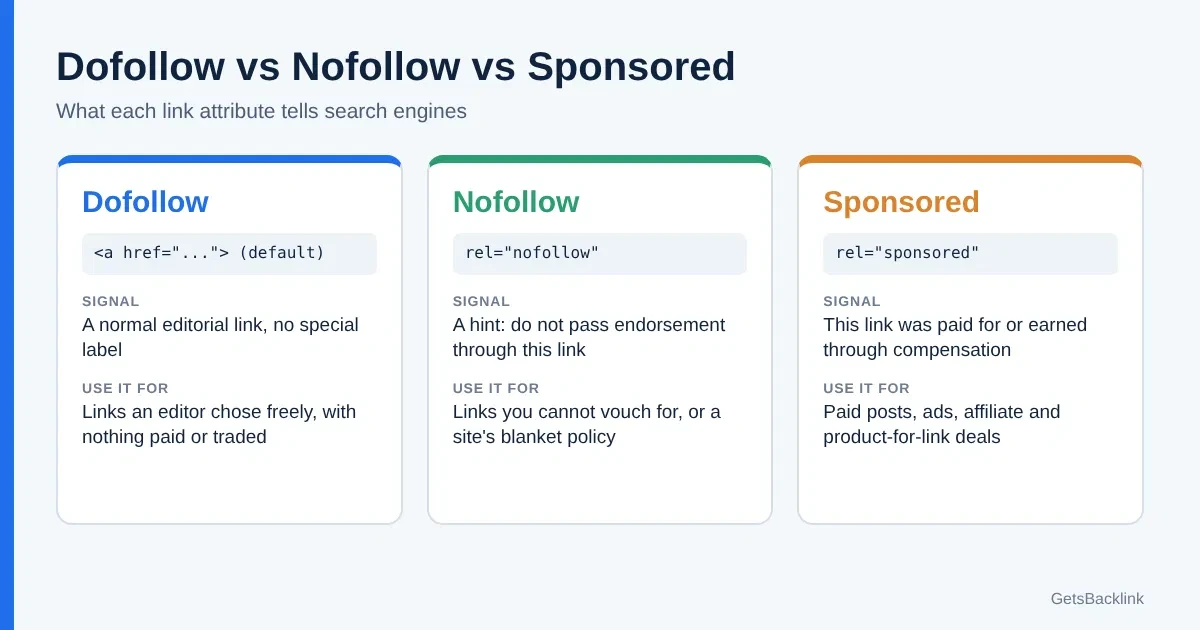
A dofollow link is a normal link with no special label. A nofollow link carries rel="nofollow", which tells search engines not to treat it as an endorsement. A sponsored link carries rel="sponsored", which marks it as paid or earned through compensation. For guest posts, what matters most is not which label you get but whether the link is honest, relevant, and placed on a site worth being linked from.
People spend a lot of energy chasing dofollow links, and I understand why. But I have seen plenty of guest posts with a nofollow tag that still sent steady traffic and brand mentions, and plenty of dofollow ones on weak sites that did nothing. The attribute is one detail. It is not the whole story.
What each link type actually means
Dofollow is not an official HTML attribute. It is shorthand for a link that has no rel attribute at all, so search engines can follow it and may use it as a signal. Every ordinary link on the web is dofollow by default.
Nofollow was introduced to fight comment spam. Since 2019, Google treats it as a hint rather than a strict instruction, which means it may still crawl the link and use it in some ways.
Sponsored was added at the same time to label advertising, paid placements, and other compensated links. It tells Google the link exists because of an arrangement, not because the editor spontaneously recommended the page.
There is also rel="ugc" for user-generated content such as forum posts and comments. It is less relevant to guest posting, but you will see it on community sites. Google explains all four in its guidance on qualifying outbound links.
Dofollow vs nofollow vs sponsored at a glance
|
Dofollow |
Nofollow |
Sponsored |
|
|---|---|---|---|
|
HTML |
No |
|
|
|
What it signals |
Normal editorial link |
Do not treat as an endorsement |
Paid or compensated link |
|
Passes ranking signals |
Yes, as a normal link |
Treated as a hint, may be used |
Treated as a hint, may be used |
|
Referral traffic |
Yes |
Yes |
Yes |
|
Typical on guest posts |
Free contributions, earned links |
Editor policy, risky sources |
Paid placements |
|
Disclosure needed |
No |
No |
Yes, this is the label |
Which one matters for guest posts?
The honest answer is that it depends on how the guest post came about.
If you earned it for free. An editor accepted your article on merit and left the link alone. A normal dofollow link is fine, and that is the version most people want.
If you paid for it. Google's guidance says links that exist because of payment should be marked sponsored or nofollow. Publishers who follow the rules will add the label themselves, and you should not ask them to hide it. Our breakdown of guest post costs in 2026 explains what you are really paying for, and why a clean, labelled placement is not worthless.
If the site nofollows everything. Some quality publishers nofollow all external links as a house rule. That does not make the placement useless. You still get readers, brand exposure, and the kind of mixed link profile a real site would have.
Google has also been direct about guest posting at scale. Large campaigns built around keyword-rich links can fall under its link spam policies, whatever the attribute says. So a dofollow tag on a low-quality site is not a safe bet either.
Why a nofollow or sponsored link can still be worth it
It is easy to dismiss anything that is not dofollow. Here is what you would be giving up:
- Referral traffic. Readers click links regardless of the attribute behind them.
- Brand visibility. Your name appears in front of an audience you would not otherwise reach.
- A natural-looking profile. Real sites have a mix of followed, nofollowed, and sponsored links. A profile of only dofollow links looks engineered.
- Possible indirect value. Google treats nofollow and sponsored as hints, and mentions can help people find and cite you over time.
None of this means you should accept any link on any site. It means the attribute should not be your only filter.
What to check before you accept a guest post link
- The site first, the tag second. Traffic, topical relevance, and editorial standards matter more. Our guide on evaluating a website before buying a backlink walks through the checks.
- The link policy. Ask how the publisher marks guest and paid links, and agree it in writing before you pay.
- The anchor text. A perfectly labelled link with a stuffed keyword anchor still looks manipulative. See our anchor text strategy for guest posts for what to use and what to avoid.
- The article quality. A thin post is a weak asset whatever the tag. How to write a guest post that gets approved covers what makes content worth linking to.
- The live page. After publishing, inspect the link and confirm the attribute matches the agreement.
How to check a link's attribute
Open the page, right-click the link, and choose Inspect. Look at the tag and read its rel value. No rel means dofollow. If it says nofollow, sponsored, or ugc, you have your answer. Many SEO browser extensions will also highlight link types for you.
Mistakes to avoid
- Paying for dofollow and calling it editorial. If money changed hands, label the link properly.
- Judging a placement by its tag alone. Relevance and quality come first.
- Using the same keyword-rich anchor on every post. Attribute choice cannot fix an unnatural pattern.
- Ignoring the rest of the strategy. Placements and in-content additions work differently, as we explain in guest posting vs link insertion.
- Not checking the result. Always verify the attribute and indexing after publication.
If you publish guest posts on your own site
The same rules apply from the other side. If you accept payment for a post, mark the link as sponsored, and be open with advertisers about it. Being upfront protects your site and builds the kind of trust that keeps buyers coming back. Our guide to selling guest posts on your blog covers pricing, policies, and staying compliant.
Frequently asked questions
Is a dofollow link better than a nofollow link?
Not automatically. A dofollow link from a relevant, trusted site is more valuable than one from a weak site, and a nofollow link from a respected publication can bring real traffic and visibility. Quality and relevance usually matter more than the tag.
Should guest post links be sponsored?
If you paid for the placement or gave something in return, yes. Google asks for paid links to be marked sponsored or nofollow. Links earned through genuine editorial choice do not need the label.
Do nofollow links help SEO?
They can, indirectly. Google treats nofollow as a hint, and the traffic, mentions, and brand awareness they generate can support your wider strategy. Do not expect them to work the same way as a followed link.
Can I ask a publisher to remove the sponsored tag?
You can ask, but a reputable publisher will usually decline, and you should not push. Hiding a paid relationship goes against Google's guidelines and puts both sites at risk.
What is the difference between nofollow and sponsored?
Nofollow is a general signal that you do not vouch for a link. Sponsored is specific: it says the link is paid or compensated. Google treats both as hints, and you can use them together, for example rel="nofollow sponsored".
Final thoughts
Dofollow, nofollow, and sponsored are labels that describe how a link came to exist. They are worth understanding, but they are not a scoreboard. Choose sites with real audiences, write posts worth reading, be honest about paid placements, and judge a link by what it does for readers and your brand, not only by its tag.
When you are ready to buy or sell placements on vetted sites, browse the marketplace at GetsBacklink, or read more in our Insights library.