
Quick answer
The safest anchor text strategy for guest posts is to lean on branded and URL anchors, add a small share of generic and partial-match phrases, and keep exact-match keywords rare. A natural mix looks like what real writers do: they name the company, link the page title, or describe the resource in a few words.
That is the short version. The longer one matters, because anchor text is one of the easiest places to look manipulative without meaning to. I have watched careful link builders ruin a clean profile by pushing the same money keyword into five guest posts in a row. Nothing was technically hidden, it just looked engineered.
What anchor text is and why it matters
Anchor text is the clickable words of a link. Search engines read it as a short description of the page being linked to, so it helps them understand what that page is about. It also tells readers what to expect when they click.
That dual role is the whole tension. A descriptive anchor helps SEO, but a profile made entirely of keyword-rich anchors stops looking like something people wrote naturally. Google's spam policies list large-scale guest posting with keyword-rich anchor text as an example of link spam, so the goal is balance, not maximum optimization.
The five types of anchor text
|
Type |
Example |
Risk level |
Best use |
|---|---|---|---|
|
Branded |
GetsBacklink |
Very low |
Default choice for most guest posts |
|
Naked URL |
getsbacklink.online |
Very low |
Citations, author bios, resource mentions |
|
Generic |
read more, this guide |
Low |
Occasional natural variety |
|
Partial match |
guide to evaluating a site before buying a backlink |
Low to medium |
Linking a specific article in context |
|
Exact match |
buy backlinks |
Higher |
Rarely, and only when it reads naturally |
A few notes on each:
- Branded anchors are the safest and the most natural. Editors expect them, and they build brand recognition at the same time.
- Naked URLs look plain, which is the point. They fit author bios and source citations well.
- Generic anchors such as "here" or "this article" are fine in small doses, but they tell search engines almost nothing, so do not rely on them.
- Partial-match anchors include your topic inside a natural phrase. They are the sweet spot when you link to a specific page.
- Exact-match anchors repeat the precise keyword you want to rank for. They can work, but they are where over-optimization usually starts.
What a safe anchor text mix looks like
There is no official percentage from Google, and anyone who gives you a magic number is guessing. Still, a few rules of thumb come up again and again among experienced link builders, and they match how natural link profiles tend to look: mostly brand and URL anchors, a modest amount of descriptive phrases, and very little exact match.
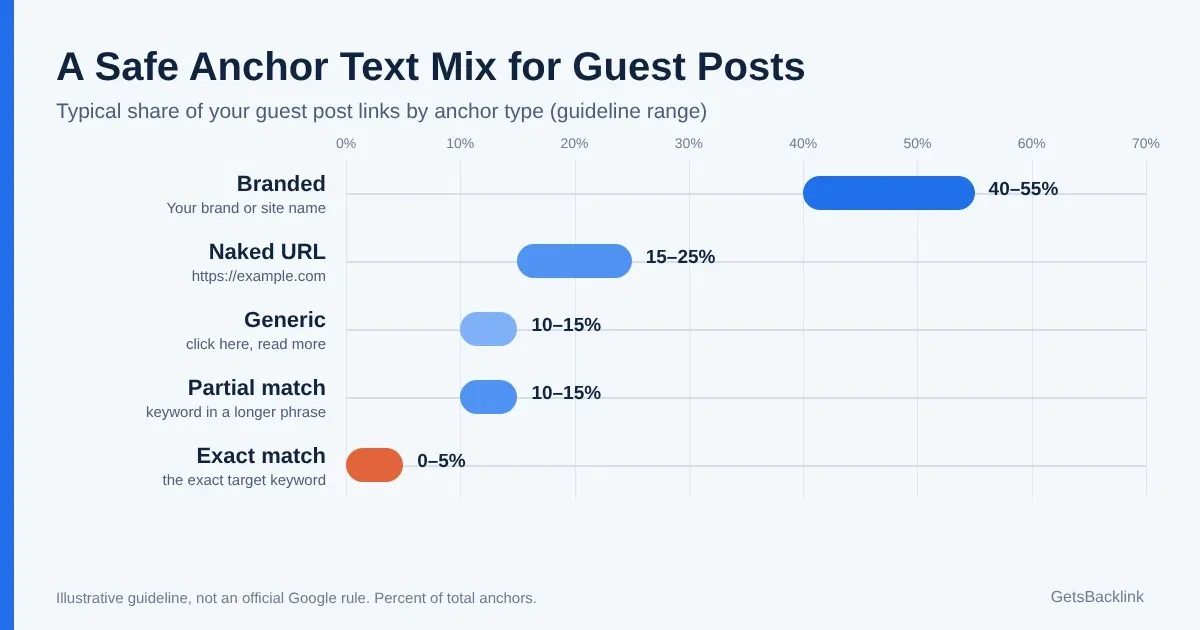
Treat those ranges as a starting point, not a quota. Competitive, established sites with strong brands can lean more on branded anchors. Newer sites in tight niches often need a little more descriptive variety to give pages context. What matters most is the overall pattern across your whole backlink profile, not any single post.
Anchor text mistakes to avoid
- Repeating the same money keyword. If every guest post uses "best CRM software" as its anchor, the pattern is obvious to algorithms and to human reviewers.
- Forcing the anchor into the sentence. If you have to bend the grammar to fit it, the link will look bought. Rewrite the sentence instead.
- Using long anchors. A whole sentence as anchor text is awkward and can look spammy. Three to six words is usually plenty.
- Linking to irrelevant pages. A tidy anchor pointing at an unrelated page confuses readers and weakens the context.
- Letting the writer decide alone. If you outsource, give a short brief with the approved anchor and target URL. Do not leave it to chance.
- Ignoring the rest of your profile. A guest post can look fine on its own and still push your overall mix too far toward exact match.
How to choose anchor text for a guest post, step by step
- Start with the target page. Decide which page the link should help and what it is actually about.
- Read the paragraph around the link. Choose words that already fit the sentence. The best anchors feel like they were always part of the text.
- Check your current mix. Look at your existing backlinks in a tool such as Google Search Console or your preferred SEO platform, and see which anchor types you already have too many of.
- Pick the least risky type that still makes sense. Branded first, then partial match, and exact match only when the profile has room.
- Place the link early enough to matter, usually in the body, not buried in a closing line.
- Mark sponsored links properly. If the placement was paid for, follow Google's guidance on qualifying outbound links, which asks for
rel="sponsored"on paid links.
A quick example
Say you run an accounting software company and want a link to your invoicing page from a small-business blog.
- Weak: "best invoicing software for small business" (exact match, forced, repeated on other sites).
- Better: "our invoicing tool for freelancers" (partial match that fits the sentence).
- Safest: "Acme Books" (branded, natural, easy for the editor to accept).
None of these is magic. The difference is that the second and third read like something a person would write.
How anchor text fits into your wider guest posting plan
Anchor text is one piece of the work. The post itself has to earn the link first, which is why writing a guest post that gets approved matters more than any ratio. The site you place it on matters just as much, so check traffic, relevance, and link profile using our guide to evaluating a website before buying a backlink. And if you are budgeting, see how guest post prices vary in 2026.
Frequently asked questions
What is the best anchor text for guest posts?
Branded anchor text is the safest choice for most guest posts. It looks natural, matches how editors link, and carries very little penalty risk. Add partial-match anchors when you link to a specific page.
Is exact-match anchor text bad?
Not by itself. It becomes a problem when it dominates your profile or repeats across many guest posts. Used rarely and in a sentence where it fits, it is fine.
How many guest post links should use the same anchor?
As few as possible. Repeating one anchor across several placements is the clearest sign of manipulation, so vary the wording and the target pages.
Does anchor text still matter in 2026?
Yes. Search engines still use it as a relevance signal, but they also look at the surrounding text, the quality of the linking site, and the whole backlink profile. Context now carries as much weight as the anchor itself.
Should I use nofollow or sponsored on guest post links?
If you paid for the placement or received something in return, mark the link as sponsored. Editorial links that were earned on merit do not need it. When in doubt, ask the publisher what they use and follow Google's guidance.
Final thoughts
A good anchor text strategy is mostly restraint. Use your brand name freely, describe pages in plain words, keep exact match rare, and let each link sit where a reader would actually want to click it. Do that consistently and your profile will look like what it should be: a record of people who found your work useful.
If you want placements on vetted sites where you control the anchor and target page, you can browse options on GetsBacklink.