
Quick answer
A guest post gets approved when it fits the host site's audience, teaches something the site hasn't already covered, and reads like the site's own editors wrote it. It ranks when it is genuinely useful, well structured, and links out and back in a natural way, not when it is stuffed with keywords or built around a single link.
I have seen both sides of this. Editors reject most pitches in the first thirty seconds, and the reasons are almost always the same: the topic is off, the draft is thin, or the link is the only reason the article exists. The good news is that all three are fixable before you hit send.
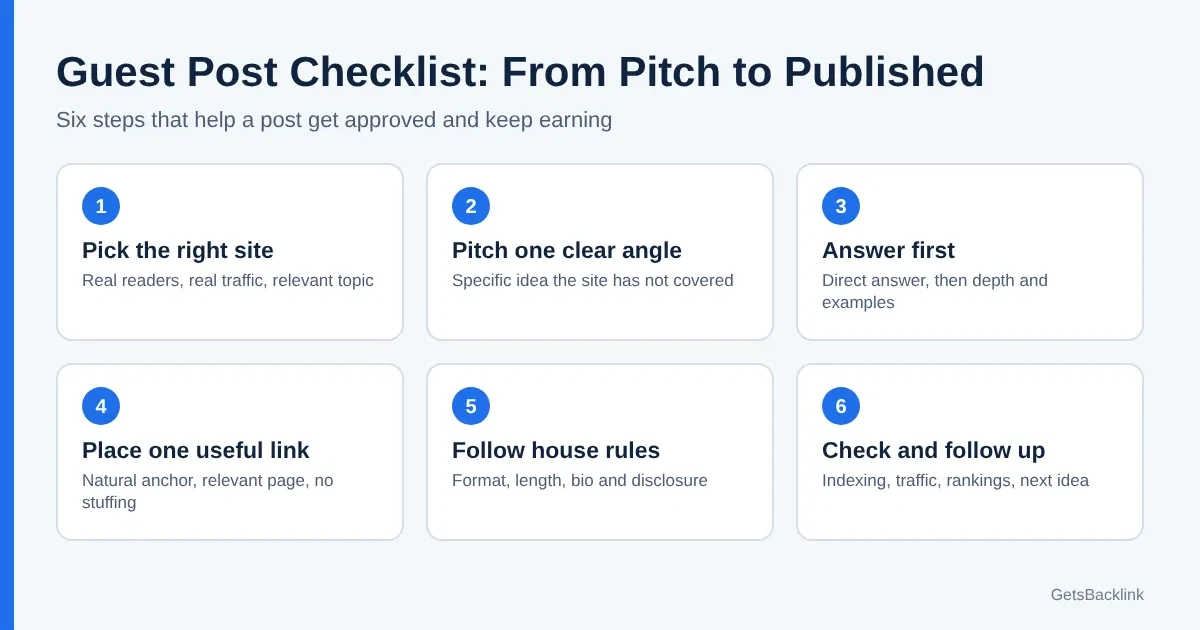
This checklist walks through what to do, in order, from picking the site to following up after publication. It works whether you write the post yourself or hand it to a writer.
In short:
- Pick a site your target reader already uses, and read its last ten posts first.
- Pitch one specific idea with a clear angle, not a generic topic.
- Write for the reader, then place one relevant link where it genuinely helps.
- Follow the host's formatting and disclosure rules to the letter.
- Track what the post actually does for you after it goes live.
Why most guest posts get rejected
Editors are not being picky for sport. They protect a readership, and every weak post costs them trust. Most rejections come down to four things:
- Wrong audience. A cybersecurity post pitched to a gardening blog never had a chance.
- Recycled content. The draft repeats what every other article on the topic says, often in the same order.
- A link-first mindset. The post exists to carry a link, and the editor can tell within two paragraphs.
- Sloppy basics. No clear structure, no sources, ignored guidelines, or an author bio that reads like an ad.
Fix those four and you are already ahead of most submissions.
Step 1: Choose a site worth writing for
Start with the site, not the topic. A guest post is only as valuable as the place it lives.
Before you pitch, read the last ten posts and look at three things: does the site publish on your subject regularly, does the content look edited, and does it have real readers (comments, shares, a visible social following, steady organic traffic)? Domain metrics such as DA or DR are a rough signal, not a verdict. A site with a modest score and a loyal audience often beats a high-score site that publishes anything for a fee.
If you are buying placements through a marketplace, our guide on how to evaluate a website before buying a backlink covers the traffic, relevance, and risk checks in detail.
Step 2: Pitch one specific angle
"Marketing tips" is a topic. "Why small B2B blogs should publish fewer, longer case studies" is an angle. Editors say yes to angles.
A pitch that gets read is short and concrete:
- A working title that sounds like something the site would publish.
- Two or three sentences on what the reader will learn and why it matters now.
- A line on why you are qualified to write it.
- Links to one or two published samples, if you have them.
Skip the flattery and the mass-email feel. Mention a recent post from the site by name and explain how your idea fills a gap. That one sentence shows you did your homework, and it is rarer than you would think.
Step 3: Write the post for the reader first
This is where approval and rankings are both won. Search engines and AI answer engines reward the same thing editors do: a clear, trustworthy, genuinely helpful page.
Open with the answer
Put a direct answer in the first 40 to 60 words. Readers get what they came for, editors see you respect their audience, and search and AI systems can lift that passage as a clean, quotable answer. Then spend the rest of the article earning the depth.
Use a structure people can scan
- One H1, and H2s that read like real questions or clear statements.
- Paragraphs of two to four sentences.
- Lists and tables where the content is genuinely a list or a comparison.
- A short summary or conclusion that says what to do next.
Add something the top results do not have
This is the part people skip. Before writing, open the first page of results for your topic and ask what is missing. It might be a real example, a small dataset you collected, a screenshot of your own process, a mistake you made and fixed, or a firm opinion backed by reasons. First-hand experience is the hardest thing to fake and the easiest thing for a reader to feel. It also lines up with what Google calls experience and expertise in its quality guidance.
Write like a person
Use plain words. Vary your sentence length. Say "use" instead of "utilize." If a sentence sounds like a brochure, rewrite it the way you would say it to a colleague. Run your draft through a read-aloud pass: where you stumble, your reader will too.
Step 4: Place links the way an editor would
Links are why many people write guest posts, and also why many guest posts fail. The rule is simple: add a link only where it helps the reader.
- Use one to two links to your own site, no more, and point them at pages that are actually relevant to the paragraph they sit in.
- Prefer natural anchor text. A brand name, a page title, or a short descriptive phrase works. Repeating the same exact-match keyword across posts is a pattern Google's link spam policies warn against.
- Link out to credible sources. Citing a study, a documentation page, or a respected publication makes the post more trustworthy and shows you did the research.
- Respect the host's link rules. Sponsored or paid placements should be marked with
rel="sponsored"where required, as Google explains in its guidance on qualifying outbound links. Many editors add the attribute themselves, so ask rather than argue.
If you are weighing a post against a quick insertion into an existing article, see guest posting vs link insertion for how the two compare on cost and impact.
Step 5: Follow the house rules exactly
Guidelines are a free preview of what the editor will check. Read them twice, then check your draft against them before sending.
|
Item |
What to confirm |
|---|---|
|
Word count |
Match the stated range, and do not pad |
|
Formatting |
Heading levels, list style, image format and size |
|
Author bio |
Length, tone, and where links are allowed |
|
Originality |
Unpublished anywhere else, and not heavily AI-generated without edits |
|
Sources |
Linked, current, and from reputable publishers |
|
Disclosure |
Any required note about sponsorship or affiliation |
Deliver the draft in the format the site asks for, usually a Google Doc or a clean document file, with images credited or original.
Step 6: Follow up after the post goes live
Publishing is not the finish line. A few checks in the first month tell you whether the post did its job:
- Confirm the page is indexed by searching for its title in quotes, or using the URL Inspection tool in Google Search Console if you have access.
- Check the link is live, in the right place, and carries the attributes you agreed on.
- Track results. Watch referral traffic, impressions for the target keyword, and any lift in rankings for the linked page.
- Share the article with your own audience and thank the editor. A good relationship is how the next pitch gets approved faster.
If you are also thinking about cost and return, our breakdown of guest post prices in 2026 helps you judge whether a placement was worth it.
Common guest posting mistakes to avoid
- Pitching without reading the site first.
- Writing a thin 600-word post that says nothing new.
- Stuffing exact-match anchors or placing several promotional links.
- Ignoring formatting and disclosure rules.
- Reusing the same article on multiple sites.
- Disappearing after publication instead of checking results.
Frequently asked questions
How long should a guest post be?
Use the host's stated range. If there is none, 1,200 to 2,000 words is a safe target for most topics, but depth matters more than length. Stop when the question is fully answered.
Do guest posts still help SEO in 2026?
Yes, when they come from relevant, editorially run sites and earn their place. A single link from a trusted, topically related page can help. Links from low-quality sites built purely to sell placements can do nothing, or cause harm.
How many links can I include in a guest post?
One or two links to your own site is the usual limit, plus any citations to outside sources. More than that tends to look promotional and is a common reason editors push back.
Should a guest post be written with AI?
AI can help with research and outlines, but publish only what a human has fact-checked and rewritten in a real voice. Editors can spot generic drafts quickly, and unedited AI text rarely adds anything new.
How long does it take for a guest post to rank?
Indexing can take from a few days to a few weeks. Ranking improvements, when they come, usually build over several weeks to months depending on competition and the strength of the host site.
Final thoughts
A guest post that gets approved and ranks is rarely a trick. It is a useful article, on the right site, written for a real reader, with a link that earns its place. Work through the six steps above, treat the editor as a partner, and measure what happens afterwards.
If you would rather skip the outreach and go straight to vetted sites, you can browse placements on GetsBacklink, or sell guest posts from your own blog with our step-by-step guide.